Decoding Parasite
Last year, The New York Times named Parasite, Bong Joon Ho’s 2019 masterpiece, as the best film of the 21st century. Let’s revisit the movie and examine its themes and Bong’s filmmaking style through theoretical lenses.
*Notes: This essay contains movie plot and spoilers. Click on each image to see the caption.
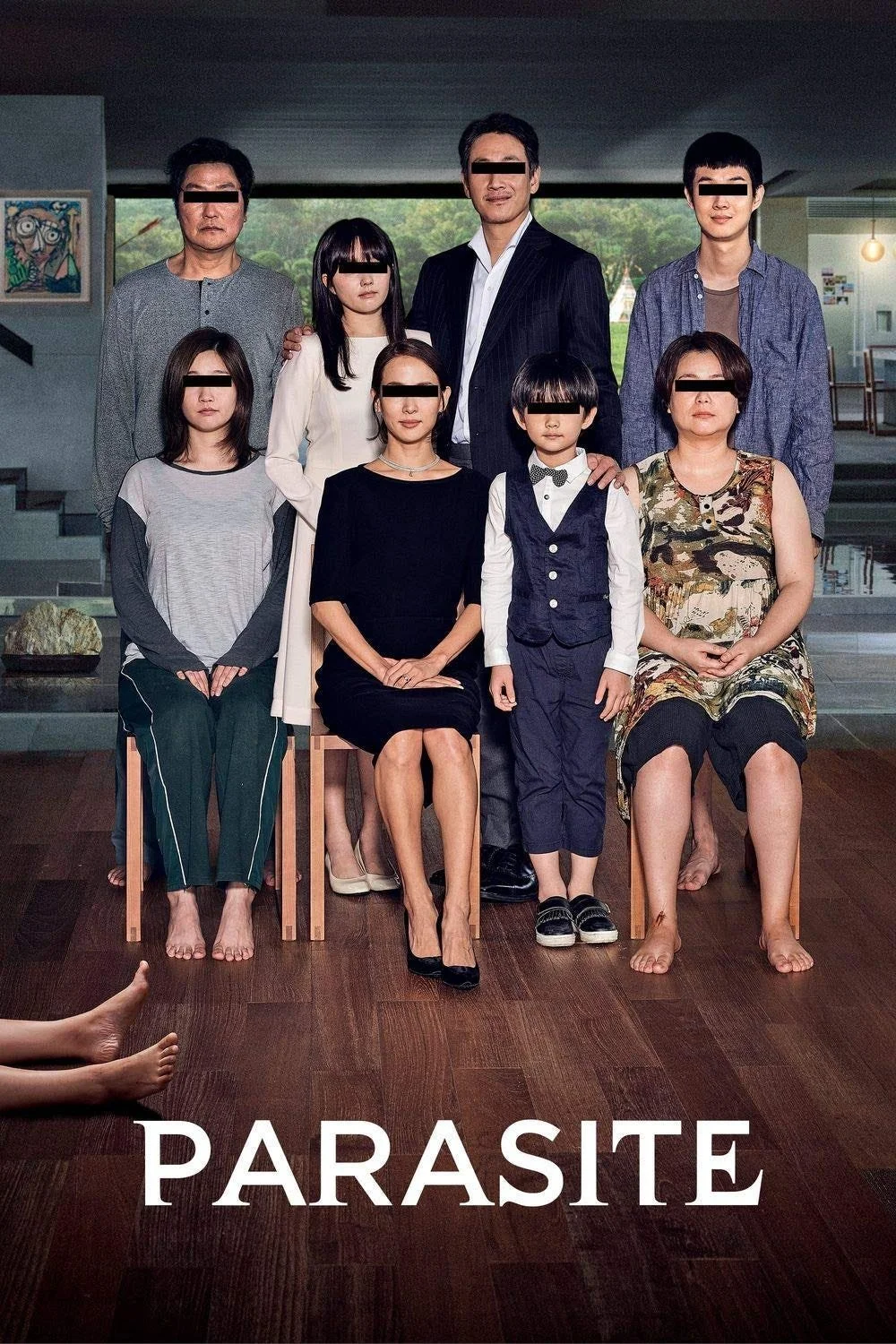
Parasite (2019) movie poster (CJ Entertainment)
At the 92nd Academy Awards, a South Korean film made history as the first non-English-language movie to win Best Picture. Bong Joon Ho’s Parasite has shaken up the cinema world since its premiere at the Cannes Film Festival seven summers ago, where it took home the prestigious Palme d’Or and sparked many conversations. Bong has been exploring social and class themes throughout his career, from his debut feature, Barking Dogs Never Bite (2000), to his latest Hollywood venture, Mickey 17 (2025). In Parasite, with fast-growing Seoul as the backdrop, Bong masterfully applies semiotics and psychoanalysis to explore several transnational issues, such as class disparities, social inequality, moral corruption, and the nature of deception.
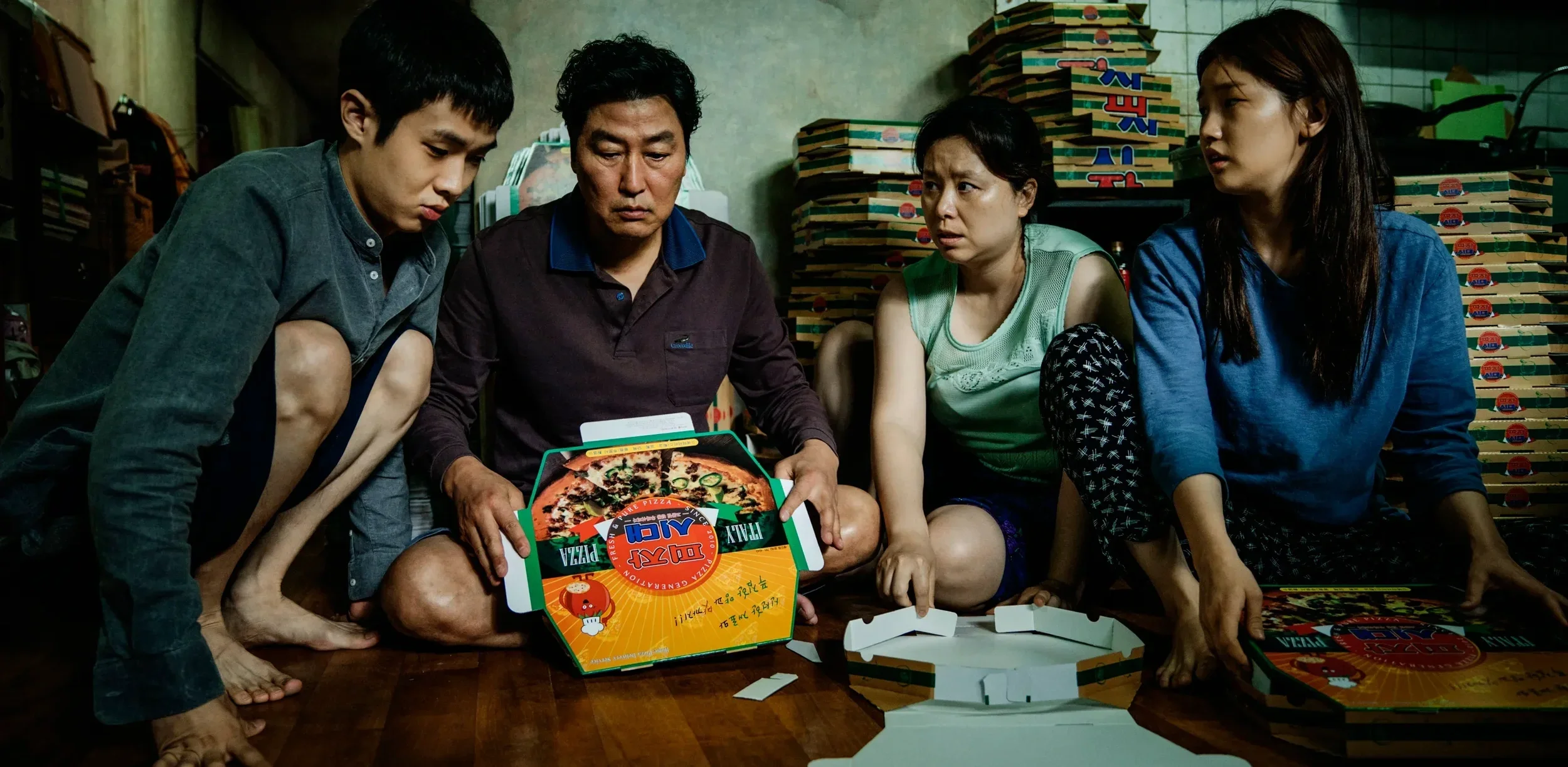
The Kim family (Barunson E&A)
The film opens with a view from the Kim family’s window. They live in a semi-basement flat, known in Korean as a banjiha, and struggle with poverty. The family includes Ki-taek (father), Chung-sook (mother), Ki-woo (son), and Ki-jung (daughter). Their life changes when Ki-woo’s friend, Min-hyuk, gives them a scholar’s stone, which is believed to bring them great fortune, and offers Ki-woo his current job as an English tutor for Da-hye, the daughter of the Park family. Ki-woo then fakes his identity as a university student and gets hired by Yeon-gyo, Da-hye’s mother. The members of the Parks, an ultra-affluent household, are consecutively introduced. Their wealth mainly comes from Park Dong-ik’s (father) tech business. They also have a young son named Da-song, who has PTSD from seeing a “ghost” in their kitchen a few years ago. The Park family has a chauffeur and a live-in housekeeper, whose jobs are gradually taken over by the Kim family members. The Kims plan their infiltration and take advantage of the Parks’ naivety to secure employment at the Parks’ home. Their plan seems to work for a while, but then dark secrets start to be revealed, and a streak of tragedies follows. It is a classic Bong’s tonal shift: a comedy swiftly turns into a thrilling horror in the most unexpected way.

The Park family (Barunson E&A)
One of the best methods to unpack the layers of Parasite is to analyze the film through a semiotic lens. The film features many symbols and motifs, and there are three that strongly reinforce its themes: the scholar’s stone, water, and smell.
The Stone
Known in Korean as suseok, the scholar’s stone is a symbol of good fortune in East Asian culture. In Bong’s film, the rock is gifted to the Kim family by Min-hyuk with the hope that it will give them material wealth. The Kims appear very pleased with the gift because the stone “promise” is exactly what they need to escape poverty. For Ki-woo, the stone is very special, and he quickly becomes attached to it. Throughout the film, Ki-woo imitates Min-hyuk, a well-educated and successful young man with many aspirations. When he takes over Min-hyuk's job as the English tutor, he also takes over his friend’s identity, and being like his friend is the only way for him and his family to improve their socioeconomic status. The stone represents his goals and dreams for a brighter future. As the film goes on, the scholar’s stone shifts its meaning, significantly after the severe flood that almost destroys the Kims’ home. Instead of being a symbol for the hope of upward social mobility, it now symbolizes the empty promises and artificiality of pursuing wealth. The stone brings hopeless people false hopes and illusions. It is also used as a weapon both by and against Ki-woo, indicating the destructive consequences of social climbing, especially with deceitful actions. While trying to better his family’s life, Ki-woo loses himself and does whatever it takes to protect their lies. It is bleakly poetic that Ki-woo is later bludgeoned with the same rock that he once treasured dearly. His aspiration for a higher social status nearly kills him.
Additionally, the scholar’s stone acts as a warning for a shortcut to success. Ki-woo is fascinated by the rock and the idea that it will bring good fortune. He did not try to seek a better life before the rock’s arrival. He impersonates Min-hyuk instead of working towards becoming someone as smart as his friend. Perhaps because the Kims have been in the poverty trap for so long and have had limited opportunities, Ki-woo does not have any other choice but to choose the shortcuts. At the end of the film, after recovering from his injury, Ki-woo places the rock in the river where it belongs. This could be read as Ki-woo finally accepts his fate and gives up on his dreams, or it could be read as Ki-woo has realized the cataclysmic results of chasing wealth and chosen a slower but more proper path to success. The second interpretation seems to work better with the film’s ending.
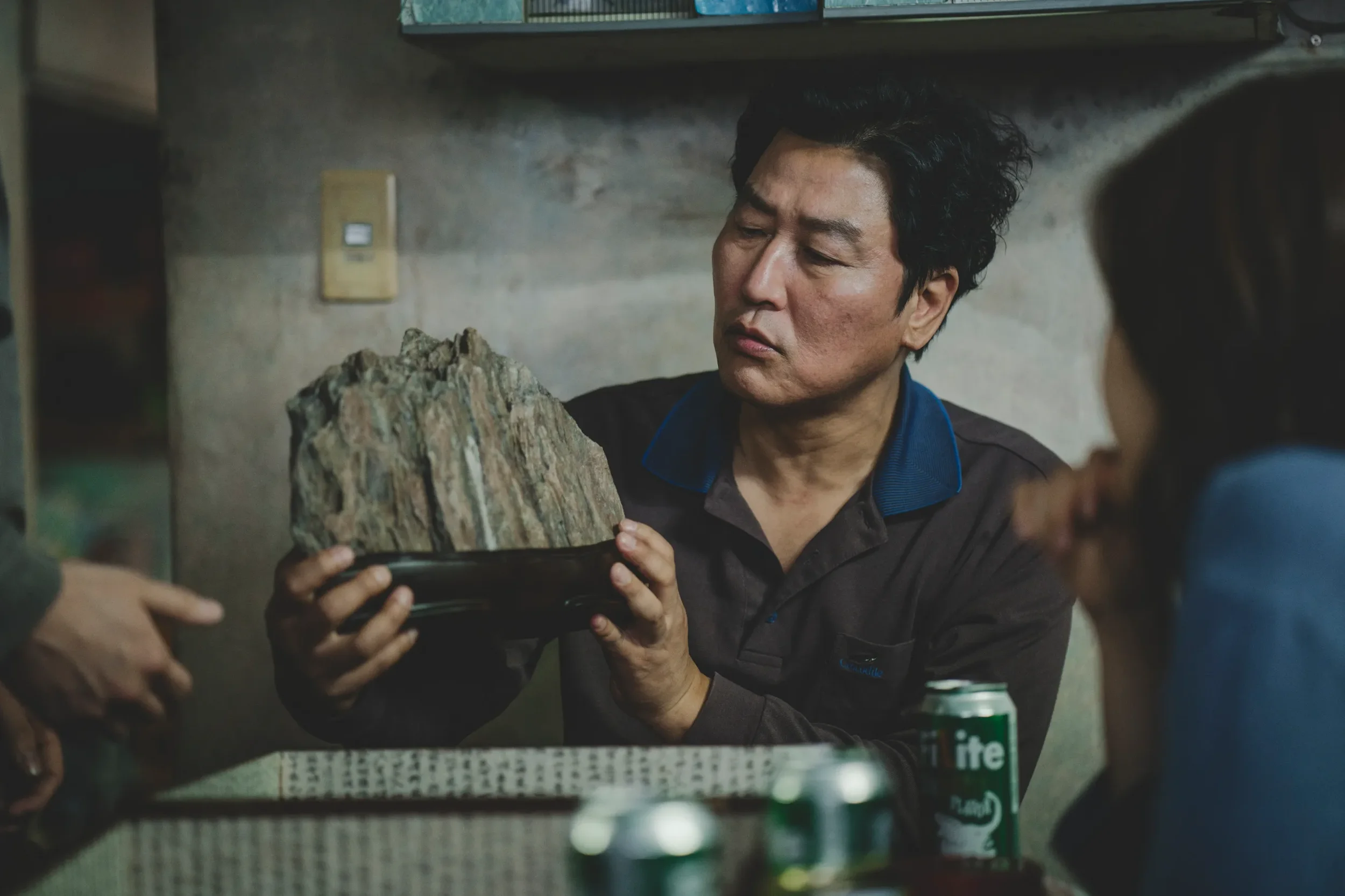
The scholar’s stone (Barunson E&A)
The scholar’s stone, a symbol that is widely perceived to attract prosperity, could actually bring misfortunes, a twisted humor that is on-brand for Bong Joon Ho. Another humorous detail is when Ki-woo first hears about what the rock represents, he goes, “Wow! It’s so metaphorical!” Bong playfully challenges symbolism and viewers’ reading of the film. The director explains this in an interview, “Korean audiences are very perceptive about interpreting and analyzing all the symbols in films, so I was having fun with that. […] Is it still a symbol if a character outright tells you that it is? What does that mean?” (Brzeski, 2020).
The Water
In Parasite, the scholar’s stone is often associated with water. Water is a recurring image throughout the film, from smaller moments, such as the Kims using water to shoo away the drunk man urinating by their window or a close-up shot of the sink water and the river, to more crucial plot scenes, like the heavy rain and the flood. Rain is a constant motif in Bong’s films, signaling that something unfortunate is going to happen. The stormy night is also a turning point in Parasite. Just before the rain, the Kims finally have a nice moment together, enjoying the Parks’ home when they go camping. Right after the rain starts pouring, they have a violent encounter with the former housekeeper, Moon-gwang, and her husband, who has been secretly living in a bunker inside the Park’s house for years. During this heavy rain, the Kims’ real identities are almost revealed. Their home and neighborhood are nearly underwater. The eventful stormy night reveals darker layers of the story to viewers and uncovers the truth for the characters. The Kim family cannot escape their circumstances even after successfully faking their way into the upper-class household. Despite facing many hardships, this is the first time that the Kims appear so vulnerable and helpless in the film.
Furthermore, the rain highlights the contrast between the rich and the poor. The Parks consider it a blessing, a beautiful phenomenon, which they can enjoy from their million-dollar house. On the other hand, for the Kim family, the rain is a catastrophe, causing them property damage and temporary displacement. The rain and flooding emphasize the privilege of the upper class and the disadvantage of the lower one. Bong Joon Ho uses water to symbolize wealth disparity with brutal honesty.
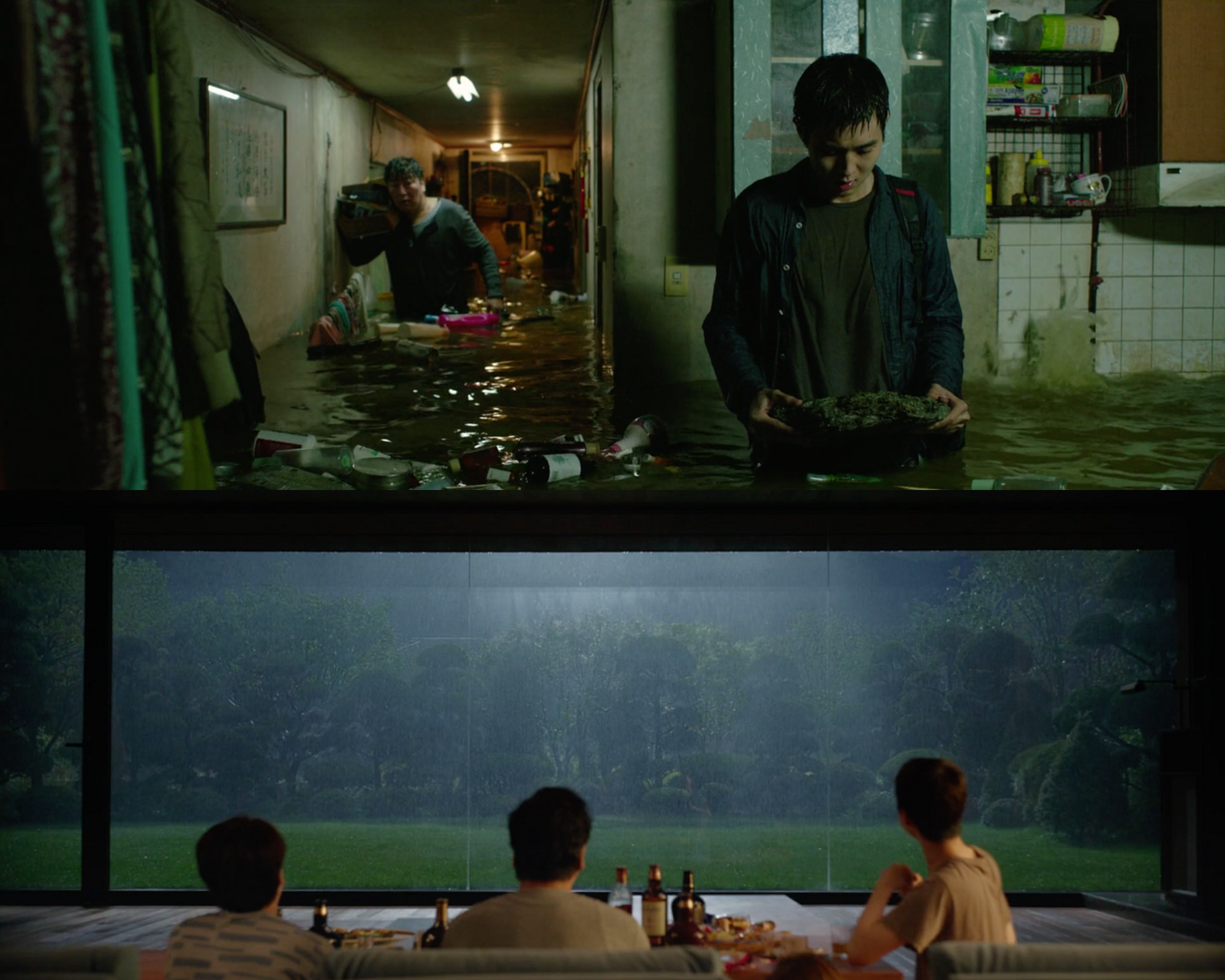
It’s raining: the Kims’ flat vs. the Parks’ mansion (Barunson E&A)
The Smell
Besides water, smell is another symbolic element Bong used to illustrate the gap between the classes. From the parents to the young son of the Park family, they all notice a certain scent from the lower-class people around them, including the Kim family and the Parks’ former chauffeur and housekeeper. Dong-ik (the Park father) comments that he smells the same odor when he rides the subway. The Kims are almost exposed as Da-song curiously points out to his parents that their new driver and housekeeper “smell the same”. Bong cleverly uses scent, something that requires viewers’ imagination, to discuss classism and social stigma. By doing so, he also invites viewers to reflect on themselves and how often they judge others based on their olfactory signals. The fact that the Parks are uncomfortable with the smell of “the poor” shows their underlying discrimination towards people who have a lower social standing than they do. Always appearing to be nice, polite, and generous, the Parks still are highly privileged people who only feel safe inside their circle and are dissociated from the rest of the world. Siobhan Lawless (2020) of The Guardian writes, “Smell ultimately shatters the Parks’ universe, while reminding the Kims that their new clothes and more generous earnings will somehow never be enough”. The Kim family cannot get rid of their body odor, just like they are unable to escape their poverty. The scent, which reflects their living conditions, is a constant reminder of their struggles and place in the social hierarchy, no matter how hard they try to conceal it.
What’s more, the Kims’ jobs at the Park’s residence often require the two families to be in the same confined settings (bedrooms, kitchen, and car), which allows them to recognize each other’s scent. The smell becomes a symbol of class distinction. The Kims’ identities are narrowed down to just their smell, representing how society only sees and judges them for their social status. Director Bong further explains this in an interview with The Korea Times, “Talking about one's body odor is taboo even among close friends, because doing so is viewed as very aggressive and rude. By talking about different smells, the film puts the class issue under the microscope” (Park, 2019). Within the Kim family, Ki-taek (the father) is most aware of the Parks’ negative attitude towards his family’s smell. He slowly grows a resentment towards the Parks over this and a series of their passive-aggressive discrimination, leading to the tragedy at the end of the film. In the most intense moment of both families’ lives, while Ki-jung of the Kims is bleeding to death from her wound and Da-song of the Parks is having a life-threatening seizure, the Park father is still bothered by the “poor people’s” smell. The climax of the film is Ki-taek’s breaking point. Mr. Park, unsurprisingly, completely lacks empathy and respect, and in this critical situation, he does not even try to hide that. Ki-taek stabs him out of anger, killing both Mr. Park and the social oppression imposed by the wealthy. The Kim father wants to break free from the cycle of poverty, exploitation, and his own fabricated life.
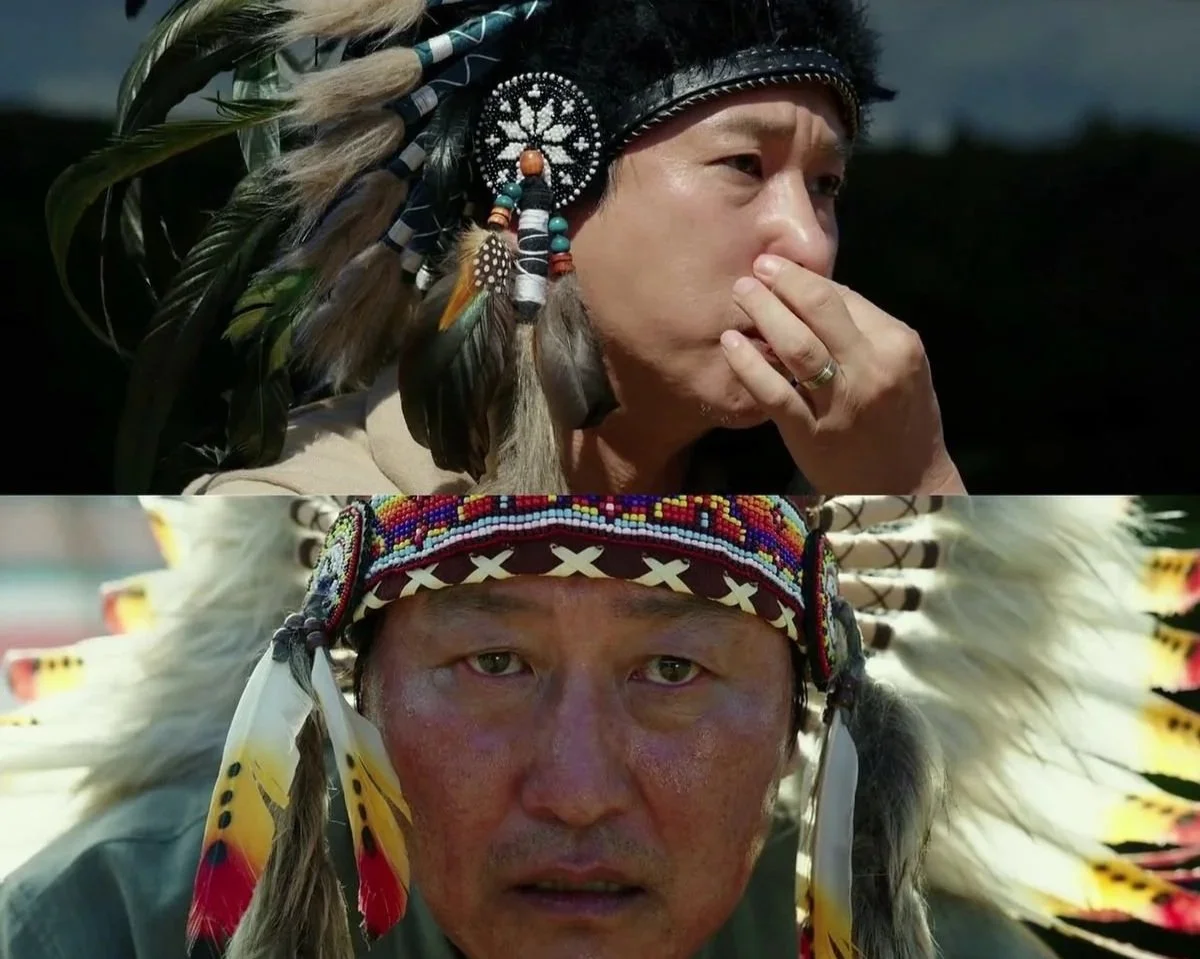
The “smell” (Barunson E&A)
According to Understanding Film Theory by Ruth Doughty and Christine Etherington-Wright (2018), which dives deep into Ferdinand de Saussure’s study of semiotics, “signs have no intrinsic meaning; meaning is given to them and established by universal and/or cultural conventions” (p.87). In Parasite, Bong gives the rock, the rain, and the smell specific meanings, making them symbols. These symbols recurrently appear in the film at different moments, becoming motifs. The choice of symbolism in the movie is quite interesting since the three mentioned above represent three out of four foundational elements in nature: soil, water, and air. The scholar’s stone is hard, rough, and can be weaponized, representing how one’s ambition can lead to self-destruction. The water is transparent, acting as a curtain between the rich and the impoverished. The smell lingers in the air, symbolizing inescapable circumstances. Environmentalism is not an uncommon theme in Bong’s films. Parasite is not straight-up about environmental issues like The Host (2006) or Okja (2017), but Bong uses these images to reflect the environment around us and the discriminatory nature of society. The class inequality is real and lurking behind us, whether we care to acknowledge that or not.
Auteurism
Additionally, Bong’s auteurism shines through the technical devices that he carefully implements in the film. The vast difference between the cinematography and lighting in the Kims’ and the Parks’ households is fascinating to look into. From the Kims’ semi-basement flat, they have to look up to see the world. Their view is limited and often filled with not-so-pleasant scenes, like a drunk guy urinating. Meanwhile, the Parks live on top of the hill, looking down on the rest of Seoul. The view is wide and breathtaking from their designer home, but it is also limited because they cannot see what happens in the “lower” areas of the city. The cameras are placed at the characters’ eye levels to convey the class divide between the two families. Moreover, the lighting shifts from one space to another, greatly supporting the story. The wealthy family’s home is always well-lit. It is filled with sunlight during the day and luxurious artificial lights at night, whereas the Kims’ home is much darker. Sunlight can only go through their little window, causing the loss of warmth even on a sunny day. They can only afford cheap lighting for when the sun goes down. The film’s cinematographer, Hong Kyung-pyo, comments, “In the end, semi-basement lighting was ‘technical lighting’ while the lighting in Park’s house was ‘aesthetic lighting” (Desowitz, 2019).
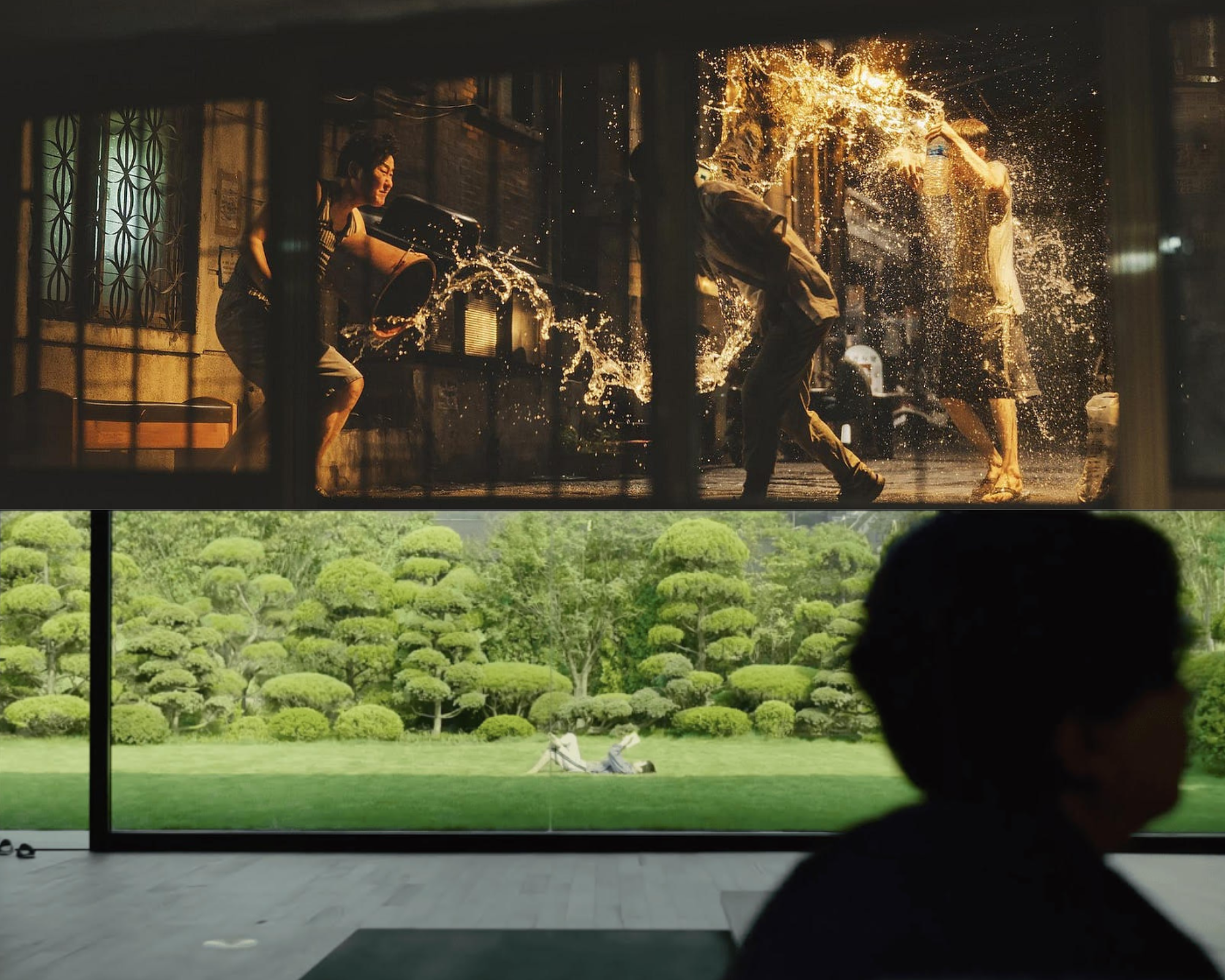
The contrasting window views (Barunson E&A)
The Houses
Switching to the psychoanalytic lens, the two families’ living spaces and the image of the stairs are also significant for viewers to understand the film. The Park family’s lavish two-story house with the hidden basement represents Sigmund Freud’s three levels of the human subconscious: Id (basement), Ego (ground floor), and Superego (first floor). Several impulsive incidents and horrors happen in the secret bunker underneath their home without the Parks’ knowing. According to Freud, “The id (also known as the unconscious) is the largest part of the mind that is beyond consciousness and has a strong influence upon our actions” (Doughty & Etherington-Wright, 2018, p.158). In cinema, the id is where the villains live. In Parasite, heroes and villains are vague, but the former housekeeper’s husband, who has locked himself in the bunker for years to hide from the loan sharks, is often considered the main antagonist. He is lawless, mentally unwell, and in the end, he commits a violent murder. The discovery of the secret bunker and the housekeeper’s husband also turns the Kims more violent. To protect their lies, they are ready to hurt others. The Kim family also lives in a “basement”. Throughout the film, they slowly let the id rule, allowing their greed and lies to consume them.
In contrast, the Parks embody the superego. They mainly stay upstairs when they get home. Bong’s characters are usually morally ambiguous. However, for most of the film, the Parks are seen as good and innocent. They set out an ideal lifestyle and moral aspirations, dominating the ego of the ground floor.
A myriad of major events occur on the ground level of the Parks’ home. In films, the ego typically appears in the form of a hero. Again, there is no determined “hero figure” in Parasite. Ki-woo seems to fit in the hero’s journey the most in terms of story structure, but since the former housekeeper’s husband is the id, Moon-gwang is the most likely to represent the ego. While she was working for the Parks, we mostly saw her on the ground floor, a few times on the upper story, and later, she stayed and died in the basement. She is also the first one to learn about the Kims’ fraudulent activities. Moon-gwang is tightly connected with everyone in the story. In Doughty and Etherington-Wright’s book, they mention, “the ego must suppress and control the id” (2018, p.159), which Moon-gwang does since she has total control of her husband. Moreover, the ego is supposed to connect the superego and the id. So, when she passes away, this connection is broken. The id (her husband) is on his own. He has to find a way to feed himself, which opens up to his reappearance in front of others. After years of confinement and solitude, he develops psychological issues and becomes full-on violent.
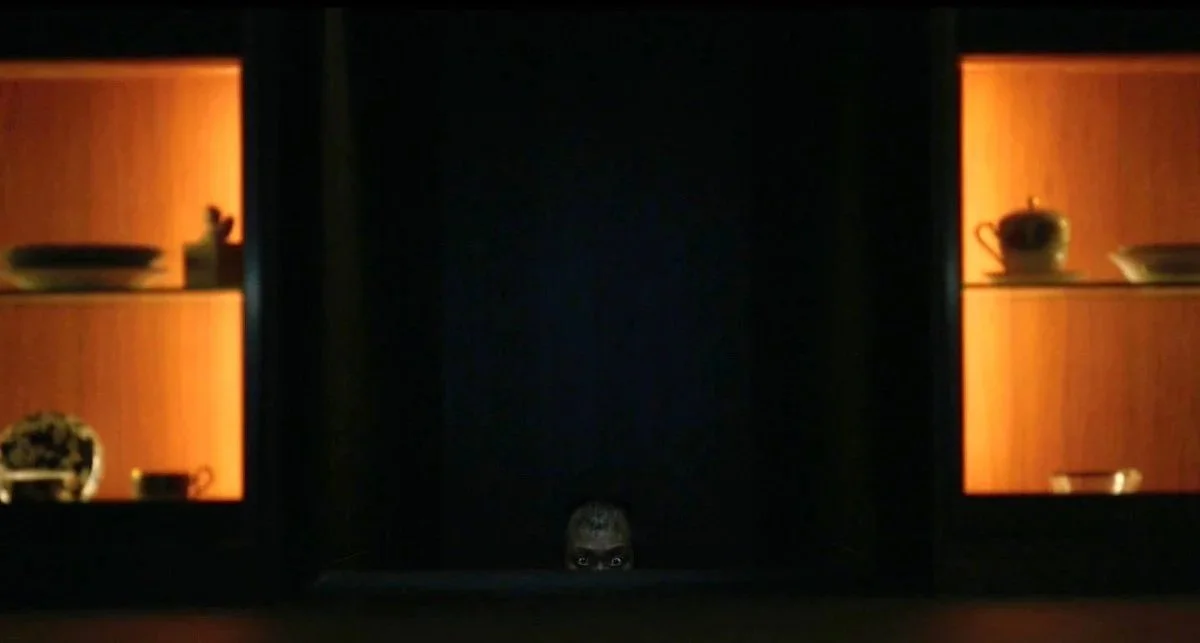
The “ghost” (Barunson E&A)
Bong is far from the first filmmaker to use a two-story house that has a basement as a metaphor for Freudian theory. Two of his biggest inspirations for Parasite are Kim Ki-young’s The Housemaid and Alfred Hitchcock’s Psycho. Both films were released in 1960, and the multi-story house is a big metaphor for the characters’ psyches in both. The objects that connect the stories in these iconic houses are the stairs. In both Kim and Hitchcock’s movies, the staircases are used to elevate suspense. Tragic deaths happen on those steps (the husband and his young son in The Housemaid and the private investigator in Psycho). In Parasite, Moon-gwang has a severe head injury after the Kim mother kicks her down the stairs leading to the bunker and dies.
The stairs are another powerful motif in Bong’s film. They appear in the underprivileged family’s home, the affluent family’s home, and the path between the two houses. In the flood scene, the Kims have to travel on foot down many grimy stairs to get to their semi-basement flat from the Parks’ residence. This is a visual metaphor for the social hierarchy. The Kims, who are in a lower social position, have to climb up to the upper class. When things take a dark turn, they have to descend numerous flights back to their place. The distance between the two families’ homes is not close, and Bong makes sure to highlight that. The staircases are steep, long, and extremely dangerous during the rain, hinting at the possible bleak outcomes of their decisions. At the Kims’ humble flat, there is also a small staircase in the bathroom, leading to their toilet. Film critic Inkoo Kang states, “Their sunken apartment was apparently built in such slapdash fashion that the toilet is perched on a platform, comically making it the highest-situated spot in the home” (2020). Director Bong’s dark humor permeates the film, making it feel less didactic and more sharply satirical.
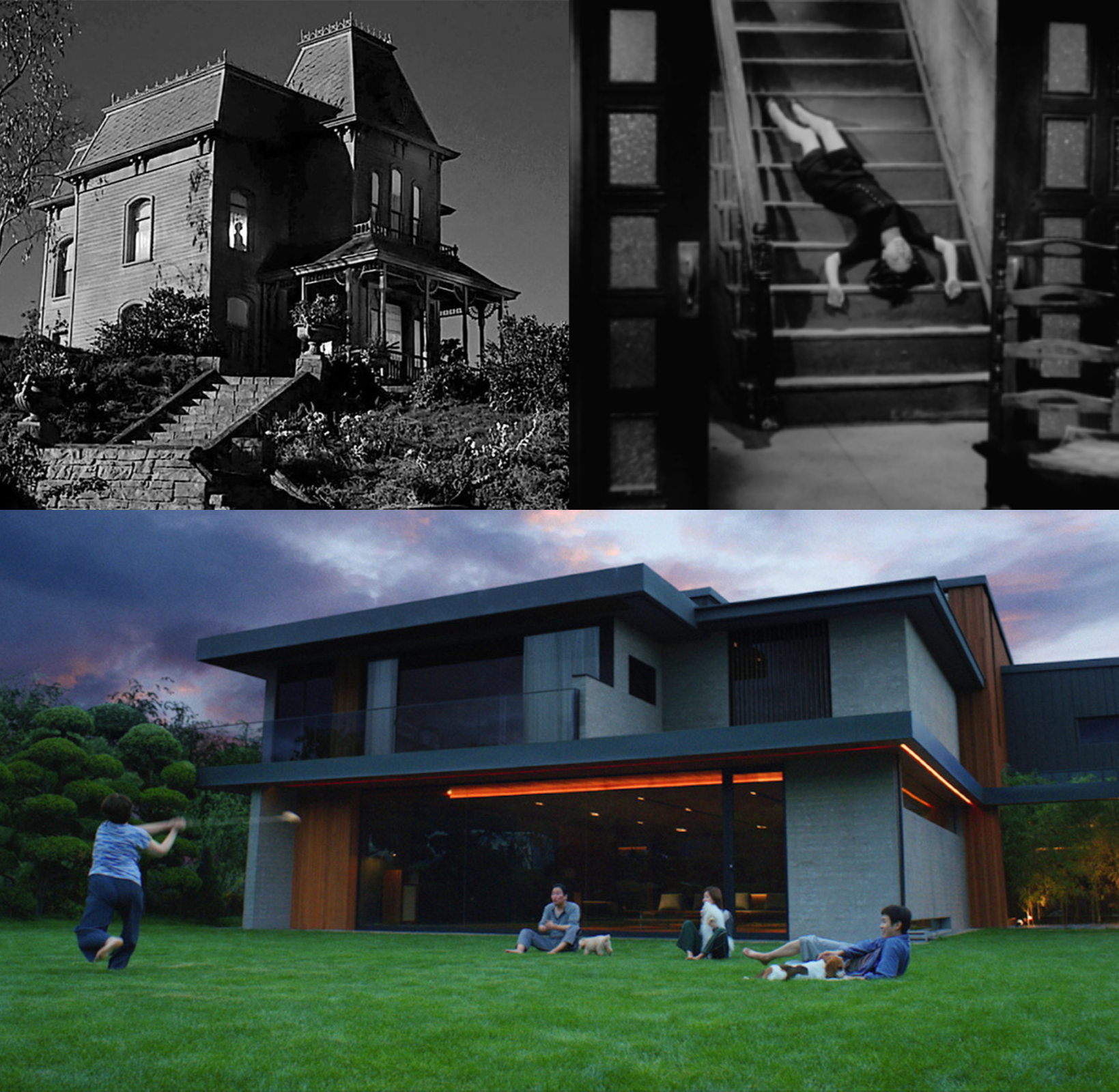
L-R/T-B: Psycho (Hitchcock, 1960), The Housemaid (Kim, 1960), and Parasite (Bong, 2019)
The Doppelgänger
Another Freudian concept that is vivid in Parasite is the uncanny, especially the doppelgänger. The Kims mirror the Parks. Both families include the parents, one son, and one daughter. Their familial structure similarities underline their social status differences even more. The Kim family also mirrors other working-class people, somewhat making it easier for them to take over others’ jobs. There is a male chauffeur that Mr. Kim can replace, there is a middle-aged housekeeper that the Kim mother can substitute, there is an unseen former art therapist that Ki-jung can fill in, and the most obvious one, Ki-woo, tries to become his friend. The title of the film contains triple meanings. Both families are parasites. One seeks to secure employment, earn money, and gain social status. One depends on the other’s labor to live opulently. Moon-gwang and her husband are also parasites. The Parks’ home becomes their hideout. The rich family relies on Moon-gwang for most domestic tasks, too. Unlike Psycho, the actual mirror barely appears in Parasite. It would be superfluous to add it since we have already had ten characters reflecting each other in the film. Lastly, the film itself mirrors the capitalist society and the harsh reality of class disparity.
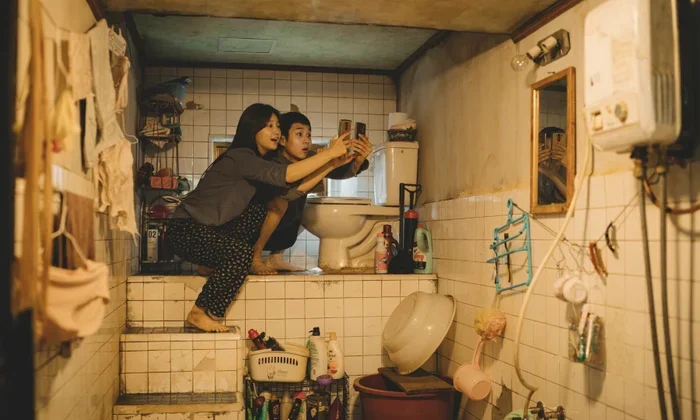
Ki-woo and Ki-jung hunt for a free and unencrypted Wi-Fi signal inside the cramped bathroom of their banjiha (Barunson E&A).
Transnationalism
Despite being a “very Korean” film, Parasite has a special global appeal. Bong’s visual style, humor, and the film’s themes travel beyond South Korea and Asia. The more obvious reason is that Parasite raises awareness about universal issues like classism and moral corruption, which resonates with people coming from different cultures and backgrounds. Nevertheless, it is Bong’s auteurism and deep understanding of multiple cultures that make the film even more transnational. His visual style contains both Western and Eastern influences, as he has studied global filmmakers since his early film club days. The two main inspirations for Parasite discussed above come from two different parts of the world. Plus, Bong’s effective storytelling style helps him reach a large audience. Some of his jokes and lines transcend cultural boundaries, which do not require the audience to understand the language or have deep knowledge of South Korean culture to get the references. Bong introduces his culture to the world and ensures it is accessible. At the same time, he blends world cinema aesthetics with South Korean film traditions, creating his distinctive brand.
The director is also no stranger to transnational productions. Bong had directed some Hollywood pictures with diverse casts and crews before his 2019 hit, such as Snowpiercer (2013) and Okja (2017). The unique aspect of Bong as a filmmaker is that his cinematic language translates well between languages and cultures. His approaches to social critique seem to work in any genre and setting, too. Cold War scholar Christina Klein describes Bong’s multiculturalism: “[Bong Joon Ho] reveals himself heir to the culturally and stylistically hybrid films of Korea’s Golden Age cinema of the 1950s and 1960s” (Leow, 2025).

The film swept the awards in 2020 and has been regarded as Bong's magnum opus (photo courtesy of ABC).
Legacy
Parasite has become a modern-day Shakespearean classic that applies the art of symbolism and Freudian theories to thoroughly discuss class division, social conflict, and morality under capitalism. Using daily imagery, such as rocks, water, smells, houses, and stairs, to unpack perplexing topics, Bong Joon Ho once again proves that he is one of the top auteurs of contemporary cinema. Bong’s visual language, as well as his film’s messages, are understood worldwide, opening up a new era of transnational cinema that is more nuanced and complex.
-
Bong, J. H. (Director). (2000). Barking dogs never bite [Film]. Cinema Service.
Bong, J. H. (Director). (2025). Mickey 17 [Film]. Warner Bros. Pictures.
Bong, J. H. (Director). (2017). Okja [Film]. Plan B Entertainment.
Bong, J. H. (Director). (2019). Parasite [Film]. Barunson E&A.
Bong, J. H. (Director). (2013). Snowpiercer [Film]. CJ Entertainment.
Bong, J. H. (Director). (2006). The host [Film]. Chungeorahm Film.
Hitchcock, A. (Director). (1960). Psycho [Film]. Paramount Pictures.
Kim, K. (Director). (1960). The housemaid [Film]. Seki Trading Co.
-
Brzeski, P. (2020, January 7). Bong Joon Ho reveals the significance of ‘Parasite’s’ scholar stone. The Hollywood Reporter. Retrieved May 24, 2026.
Desowitz, B. (2019, November 15). ‘Parasite’: shooting Bong Joon Ho’s social thriller through the lens of class divide. IndieWire. Retrieved May 24, 2026.
Doughty, R. & Etherington-Wright, C. (2018). Understanding film theory, 2nd ed. Red Globe Press.
Kang, Inkoo. (2020, October 30). Parasite: notes from the underground. The Criterion Collection. Retrieved May 24, 2026.
Lawless, S. (2020, February 2013). Common scents: how Parasite puts smell at the heart of class war. The Guardian. Retrieved May 24, 2026.
Leow, H.M.A. (2025, January 13). From The Host to Parasite: Hollywood’s hidden hand. JSTOR Daily. Retrieved May 24, 2026.
Park, J. (2019, May 29). Body odor class gap guided Bong Joon-ho's 'Parasite'. The Korea Times. Retrieved May 24, 2026.